Redesigning a Tax Software for People Who Don’t Speak “Tax”
FreedomTax Japan is an end-to-end online tax filing platform for expats living in Japan, supporting Japan income tax, US federal tax, and US state tax filings.
This case study is a condensed version. For a more detailed breakdown, check my Medium article.

Outcome
The redesign reduced user confusion, lowered support dependency during tax season, and improved completion across highly conditional tax flows.
Onboarding completion
18% → 30%
Revenue Growth
50%
Form completion rate
16% → 40%
Lead UX Designer
End-to-end redesign
Version 1 → Version 2
Income Tax Filing for Japan and US
Why this was hard
Filing taxes is already unfamiliar for most people. FreedomTax Japan supports expats living in Japan who often struggle with Japanese tax terminology while navigating multiple tax jurisdictions.
FreedomTax Japan files:
Japan income tax
US federal and state tax
15+ Supplementary tax filings
Any combination of the above
Each filing has different:
Eligibility rules
Deadlines
Documents
Compliance requirements
Most users:
Are non-Japanese
Are not fluent in tax terminology
Don’t know what applies to them
What was broken in Version 1
V1 treated tax filing like a linear form. In production, this led to abandonment, duplicate accounts, heavy support dependency, and “dumb uploads” that created manual work for accountants.
Category
Funnel
Understanding
Documents
Process
Observed issue
Users created accounts and never returned; some created multiple accounts due to CTA confusion.
Tax terms created uncertainty; users completed in multiple sessions and emailed for clarification.
Uploads existed but were passive (no validation, no extraction, no confirmation).
Less clarity regarding the overall process and next steps.
Why it mattered
Lost activation, messy user records, inflated “new user” counts.
Increased user anxiety and support load during peak season.
Accountants still had to manually extract values and resolve wrong files.
Reduced trust and increased “what happens next?” questions.
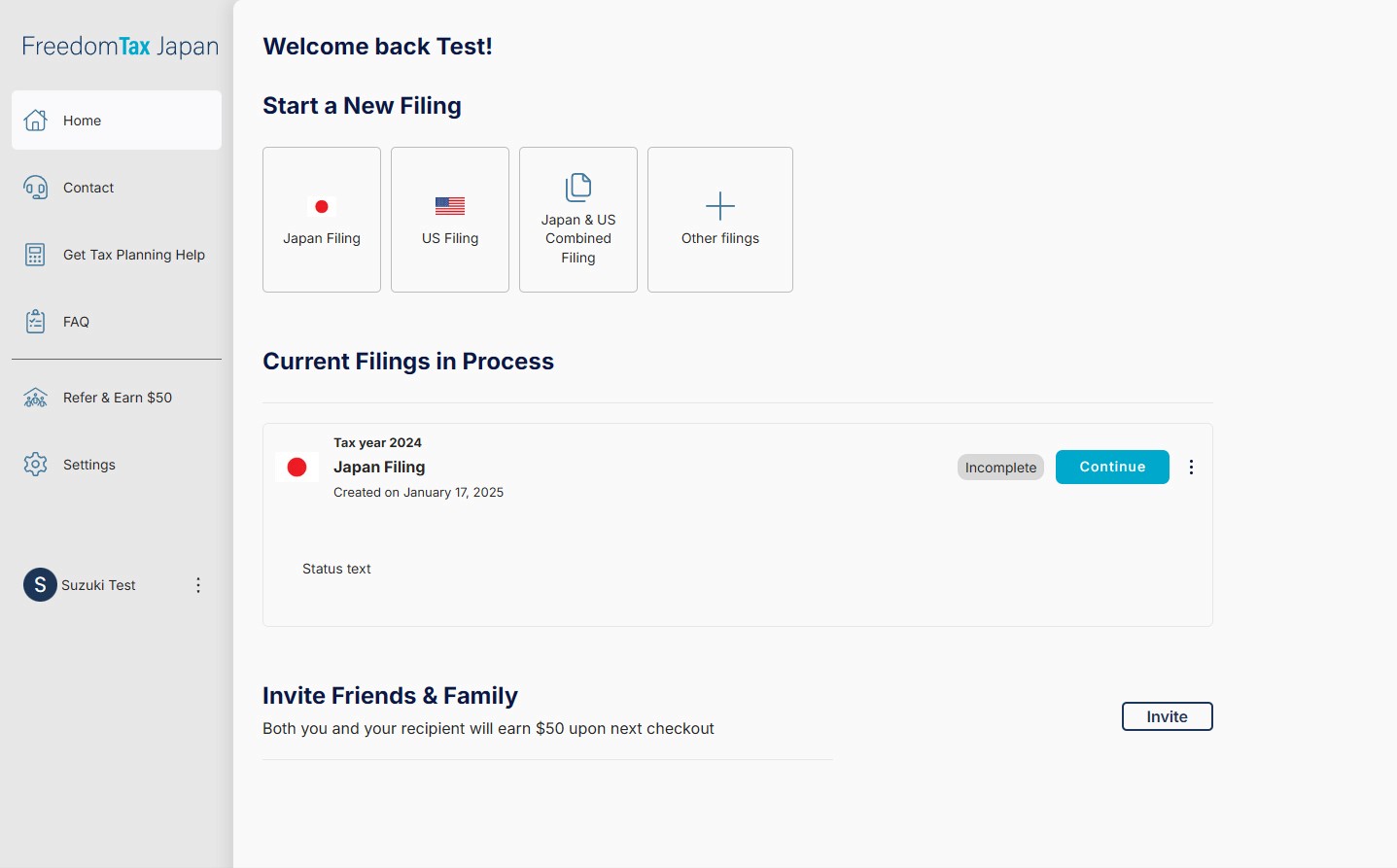
Dashboard
Status-oriented, minimal guidance. Users often asked deadline and next-step questions.
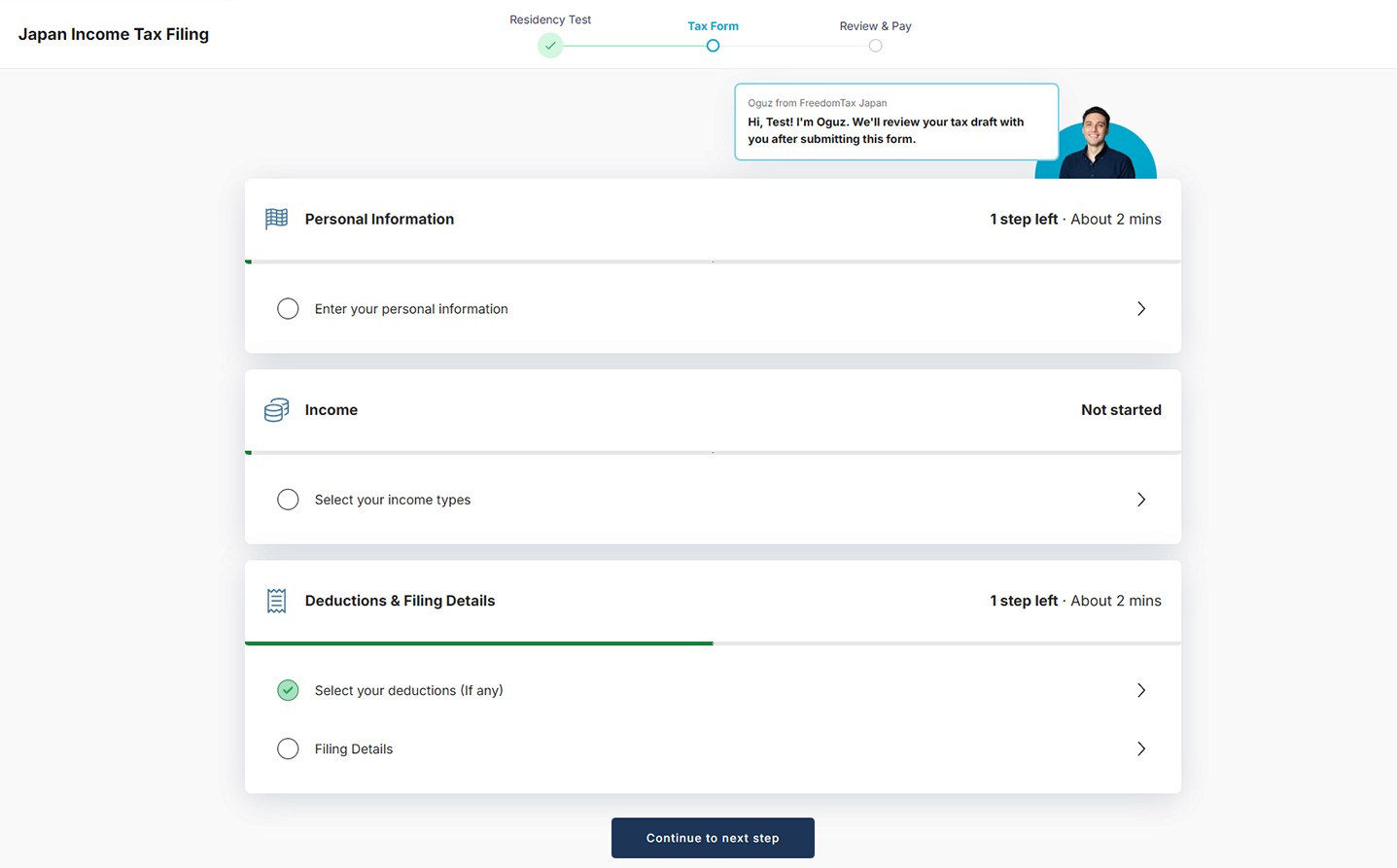
Tax Interview overview
Simple, but hides conditional depth. Users can’t predict effort or required documents.
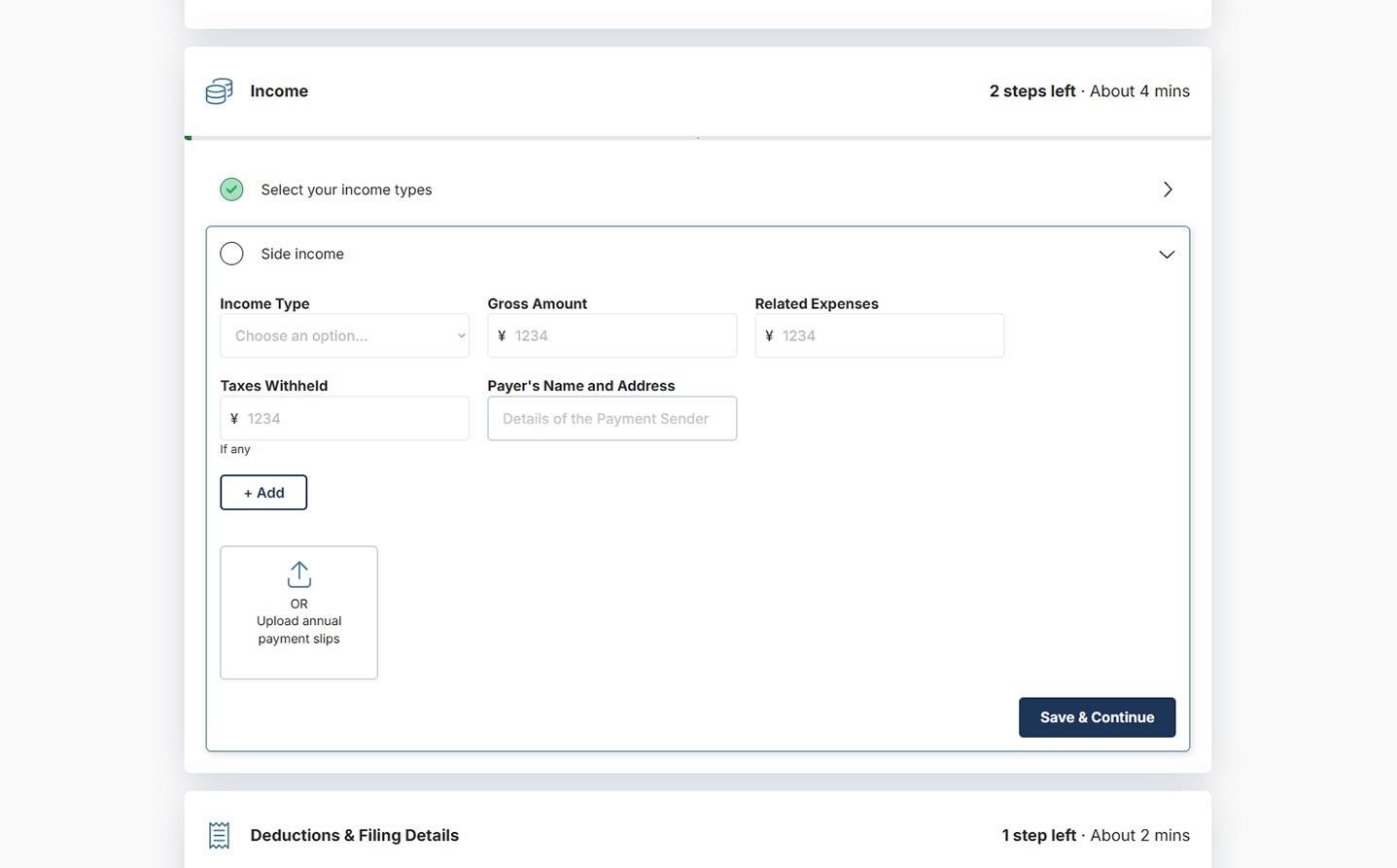
Input module example
Accountant-level inputs without strong in-context guidance.
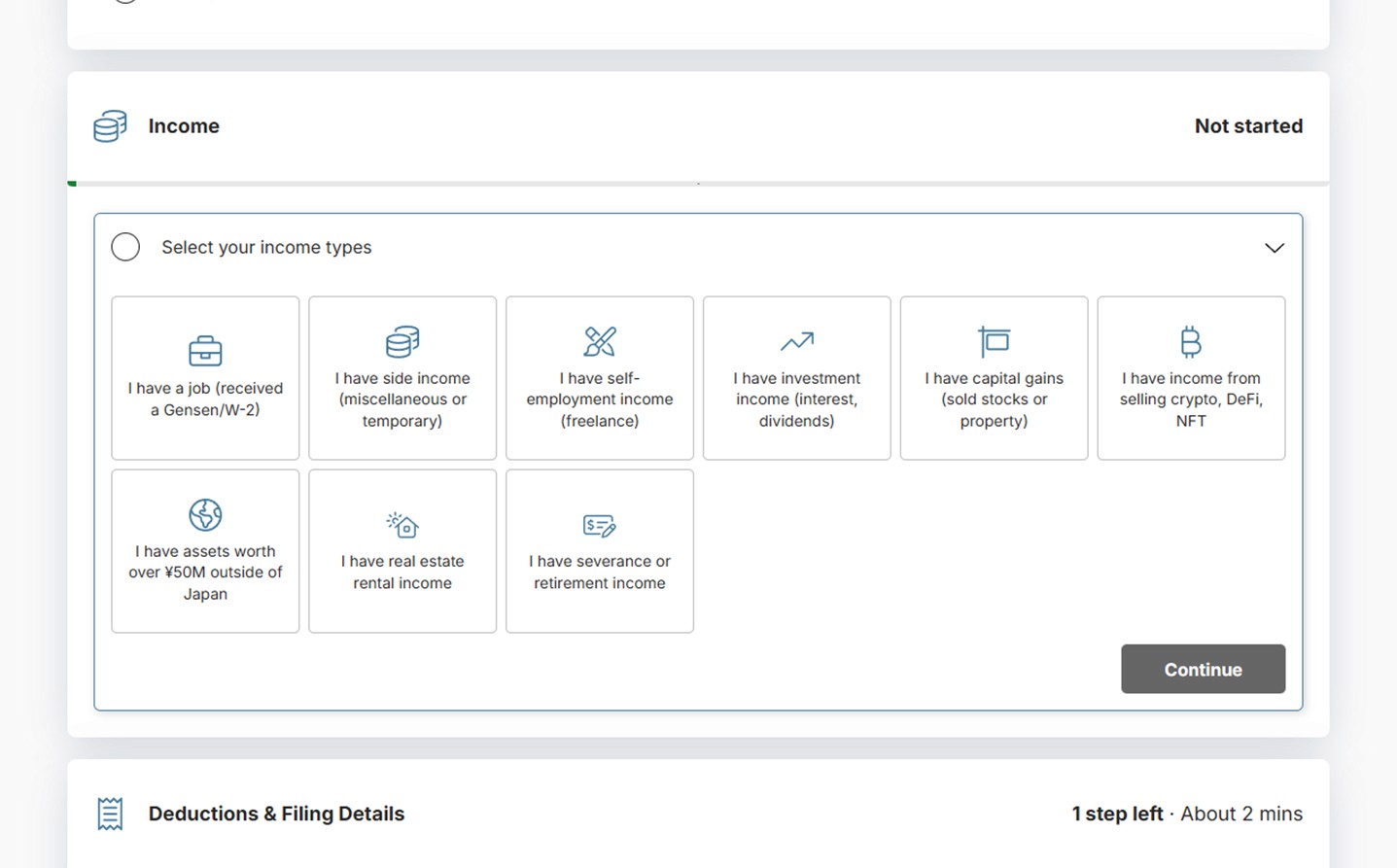
Ambiguous Selections
Options presented with minimal context, users forced to self-identify using tax terminology.
My Approach
I reframed tax filing as a state machine, not a form, then made the system explicit and safer.
Decision 1
Make system state explicit
Users always know what they’re filing, what’s next, and what’s blocked.
Decision 2
Separation before connection
JP and US pipelines are clear; data is shared via controlled prefill.
Decision 3
Gate progress with transparency
Critical steps are locked until prerequisites are met.
Decision 4
Design guardrails as core UX
Inputs are validated early, errors are surfaced immediately.
The Version 2 System
V2 retained the familiar step structure from V1, but redefined each step as an explicit system state rather than a loose UI sequence.
Setup → Income → Tax Savings → Compliance → Review & Submit.
Modules activate only when relevant. Users can file Japan, US, or both; US filing unlocks after Japan to enable prefill.
Each step:
Activates only when relevant
Is modular and condition-driven
Handles edge cases upfront
Users filing both Japan and US taxes:
Complete Japan first
See US prefilled automatically
Avoid duplicate work
What Changed (Before → After)
Version 1
Linear form + implicit logic
Dumb uploads (accept anything)
Late error discovery
Support-heavy during tax season
Limited value visibility before payment
Version 2
State-driven system with explicit pipelines
Upload → extract/validate → confirm/recover
Early guardrails + clear blockers
Product-led clarity (deadlines, guidance, contextual help)
High value visibility before commitment (real-time tax calculation)
Impact
Activation
Onboarding completion
18% → 30%
Funnel hygiene
Revenue Growth
↑ 50%
Conversion
Form completion rate
16% → 40%
Support load
Tickets per filer
↓ 68%
Ops efficiency
Handling time per filing
60 mins → 10mins
User Base
User Growth